


PII Redaction Lab
MyDecisive's SmartHub comes with a modular snap-in architecture. Octant uses it and so can you. Learn more through examples here in our platform pages. Redact PII before it leaves your network— not after you've paid to store it.
Take Control of Your Data
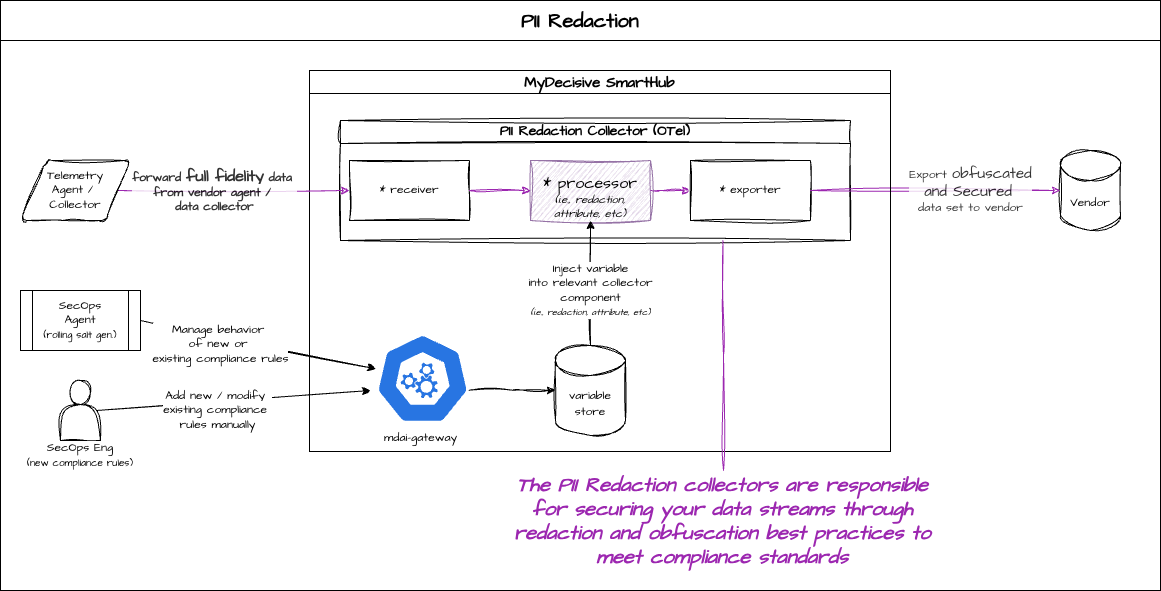
Your telemetry vendor sees more than you think. Full-fidelity logs and traces routinely carry emails, IPs, and account IDs straight into a third-party cloud — and vendors bill you by data volume, then charge again to delete what should never have left in the first place. MyDecisive moves the control point back into your network. Redaction happens in your own Kubernetes cluster, before anything is exported, so PII is never transmitted and never billed for.
Get started with docsSaaS-Centric PII vs. SmartHub PII
| Feature | Saas-Centric PII | PII in the SmartHub |
|---|---|---|
| Data control | Vendor SaaS Cloud. Raw data is collected and transmitted to the vendor for processing and storage. | Bring Your Own Cloud (BYOC). Runs in your own Kubernetes cluster — full control before data ever leaves. |
| PII control | Reactive, post-ingest deletion. You configure rules to remove data after it's already been billed and stored. | Proactive, in-flight. Programmable modules identify, redact, or drop PII at the source. |
| Cost | Billed on total volume ingested, regardless of relevance or sensitivity. | Noisy or unnecessary data is filtered before export, cutting what you pay a vendor to store. |
| Architecture | Passive Data Passthrough: Acts purely as a collection layer, routing massive volumes of raw, unfiltered telemetry directly to your backend storage. | Intelligent OTel. Intelligent OTel Hub: A programmable routing layer between apps and vendors that seamlessly proxies your existing agents with zero re-instrumentation required. |
| Context | Stateless / Limited Context. Filtering is often simple and stateless, often limiting complex, intelligent decisions. | Braided Context. Retain all related logs, metrics, and traces in-memory to enable sophisticated, high-context filtering decisions. |
The Key Takeaway: Control and Cost
How It Works
Three Steps. Entirely In-Network. By retaining Braided Context, SmartHub makes highly intelligent filtering decisions. This allows the platform to surgically redact PII from an error trace while perfectly preserving the non-sensitive diagnostic data you need for debugging.
1 Identify
Flag sensitive fields. Programmable rules scan logs, traces, and metrics as they pass through your cluster, flagging PII by pattern or field name.
2 Anonymize
Redact or mask in place. Sensitive values are anonymized or obfuscated at the source — the surrounding trace context is retained so signal isn't lost.
3 Export
Send only what is clean. De-identified, filtered data continues on to your existing vendor. Nothing sensitive ever crosses your network boundary.


