


Intelligent Trace Sampling Lab
MyDecisive's SmartHub comes with a modular snap-in architecture. Octant uses it and so can you. Learn more through examples here in our platform pages. See every trace that matters.
Perfected Tracing with MyDecisive
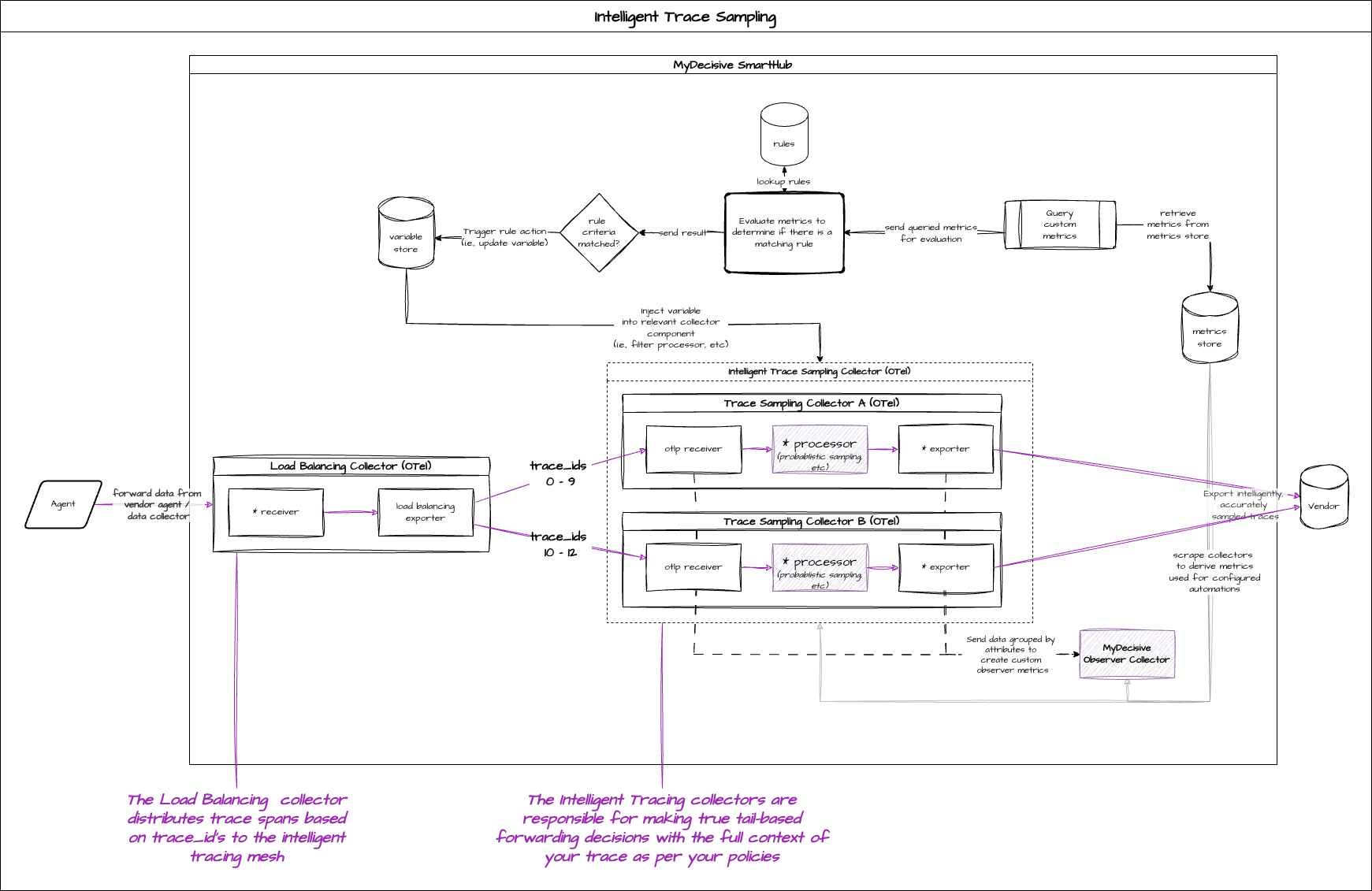
SmartHub holds every span until a trace is complete, then keeps only what's worth keeping — full signal integrity, without the cost of ingesting the noise.
Get started with docsSmartHub brings a paradigm shift with "Non-Sampling Sampling," Only SmartHub tracks 100% of spans until a trace is complete, then forwards only what's confirmed critical. Everything else stays out of your vendor bill.
Every span is captured before it ever leaves your infrastructure — nothing is dropped, sampled away, or guessed at in advance.
Spans stay in memory until the root span completes, so the system always has the complete story of a request before deciding what matters.
Sampling happens only after a trace is finished — informed by errors, anomalies, and duration patterns, not partial data or blind guesses.
Write precise rules to match any pattern in any span, so critical traces get captured and alerts fire automatically — exactly the way you define them.
Late decisions beat blind ones
The difference comes down to when a sampling system decides what to keep.
Tail-based, late-decision sampling
The SmartHub employs a refined mechanism known as tail-based sampling, managing all span data at scale while keeping it on-premises.
Decision Timing: End of the trace (when the ROOT_SPAN returns to the caller).
Context: Utilizes 100% of all span data and the final status of the request (error code, full duration, complex anomalies, etc.)
Advantages
Perfect filtering: Any trace with an error or anomaly is always kept.
Zero waste: Only high-value traces — errors, anomalies, custom patterns — reach your vendor.
Programmable rules: Retain traces by user ID, service, or any pattern you define.
Critical Compliance Benefits
Uay for high-value traces needed for active indexing and alerting, while long-term compliance archives are stored internally on S3 at a minimal cost per GB.
With filtering and redaction, sensitive information can be kept off third-party vendors, significantly reducing risk exposure.
Organizations are not bound by arbitrary vendor retention windows, which typically range from 90 days to 1 year. Compliance archives can be easily managed within their own S3/storage bucket for the required duration.
By routing traces directly to cold storage, the costly cycle of Ingest -> Index -> Store is eliminated, addressing compliance costs that often burden legacy solutions.
This approach enables finance and compliance teams to establish necessary retention policies without imposing significant vendor fees on the engineering team.


