

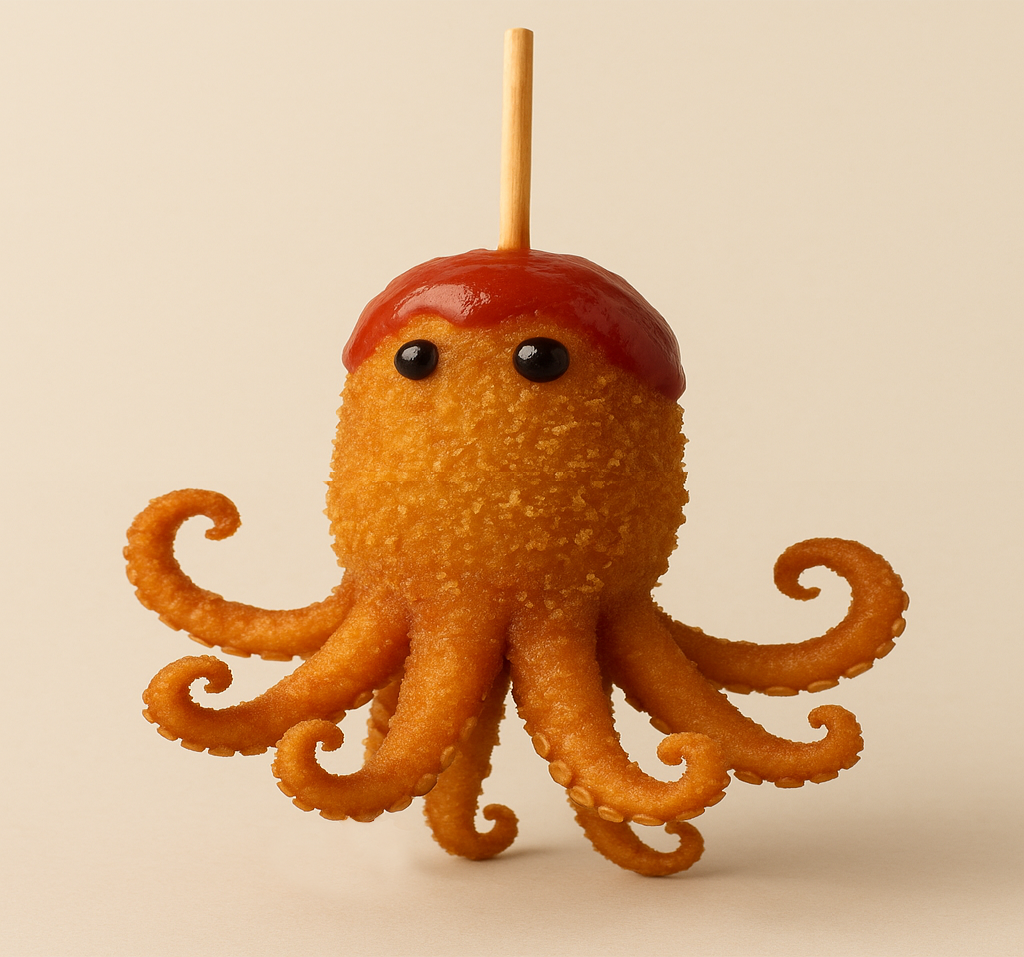
So what exactly is a steel thread in product design?
Steel Threads in Product Design: The Corn Dog Approach
When explaining steel threads to product teams, I've found that food analogies often resonate better than technical jargon. Enter the humble corn dog—a surprisingly perfect metaphor for understanding how steel threads work in product development.
The Anatomy of a Steel Thread
Picture a classic corn dog. At its core is the wooden stick—this is your steel thread. It's the foundational infrastructure that runs through your entire product, providing structural integrity and support for everything that comes after.
The hot dog represents your Minimum Viable Product (MVP) — the core functionality that delivers value to users. It's substantial enough to satisfy basic needs, but it's just the beginning of your product journey.
The cornbread coating? That's your feature set — the layers of functionality that make your product more appealing, useful, and competitive in the market.
Research has Changed our Path
We have conducted multiple interviews and surveys with technical professionals across DevOps, security, and development roles. Observability is a complicated field to say the least, and what we heard was eye-opening and fundamentally shifted our product strategy.
We made some initial guesses, but the results validated these guesses. Our users don't just want more dashboards—they want measurable results.
Building Layer by Layer
The Stick: Your Steel Thread Foundation
Just as you can't have a proper corn dog without the stick, you can't build a scalable product without steel threads. These are the core technical and architectural decisions that will support every future iteration:
- Data architecture that can handle growth
- API design that enables extensibility
- Security frameworks that protect at scale
- Performance infrastructure that won't buckle under load
The stick goes in first, and it determines how everything else will be structured. Choose poorly, and your entire product becomes unstable as you try to add features.
The Hot Dog: Your MVP Core
Your MVP is the meat of the matter—the core value proposition that solves a real problem for real users. Like a quality hot dog, it should be:
- Substantial enough to satisfy the basic need
- Simple in execution but well-crafted
- Ready to support additional layers without falling apart
The MVP wraps around your steel thread foundation, using that infrastructure to deliver core functionality reliably.
The Cornbread: Feature Development
Now comes the fun part—the cornbread coating that transforms a simple hot dog into something special. Each layer of features should:
- Enhance the core experience without overwhelming it
- Build naturally on the steel thread infrastructure
- Add genuine value rather than just bulk
Some products stop at the classic cornbread coating—and that's perfectly fine. But others push the boundaries...
The Korean Corn Dog Evolution
Korean corn dogs represent the future of your product—creative innovations that push boundaries while still respecting the foundational structure. These might include:
- *Potato cubes instead of traditional cornbread (radical UX reimagining)
- *Cheese-filled variations (premium feature tiers)
- *Multiple coating layers (complex feature combinations)
- *Unique shapes and presentations (platform-specific adaptations)
The key insight? Even the most innovative Korean corn dog variants still rely on that fundamental stick-and-core structure. The steel thread enables experimentation because the foundation remains solid.
Why This Matters for Product Teams
When you think about your product roadmap as corn dog evolution, several things become clear:
Start with the stick. Invest time in getting your steel threads right before rushing to market. A flimsy foundation will limit every future iteration.
Perfect the hot dog. Your MVP should be genuinely valuable, not just technically functional. Users need to love the core before they'll care about the coating.
Add cornbread thoughtfully. Features should enhance the core experience, not mask its deficiencies. Each layer should make the whole product better, not just bigger.
Innovate within structure. Your wildest future features still need to work within the constraints and capabilities of your steel thread foundation.
Communication Benefits
This analogy helps teams understand:
- Why infrastructure investment matters (nobody wants a corn dog that falls apart)
- How features relate to core value (cornbread without hot dog is just fried bread)
- The importance of foundational decisions (the stick determines everything else)
- How innovation builds on stability (Korean corn dogs still need sticks)
Implementation Strategy
Phase 1: Design Your Stick (Steel Thread Planning)
- Map out technical infrastructure requirements
- Identify architectural decisions that will impact all future features
- Design APIs and data models for extensibility
- Establish security, performance, and scalability foundations
Phase 2: Perfect Your Hot Dog (MVP Focus)
- Build core functionality on your steel thread foundation
- Focus on solving the primary user problem exceptionally well
- Test and iterate on core value proposition
- Ensure the MVP fully utilizes your infrastructure investment
Phase 3: Add Strategic Cornbread (Feature Development)
- Prioritize features that leverage your steel thread capabilities
- Build each feature to enhance, not compete with, core functionality
- Maintain architectural consistency across feature additions
- Test how new features interact with existing capabilities
Phase 4: Explore Korean Innovation (Advanced Features)
- Experiment with creative feature combinations
- Develop platform-specific adaptations
- Create premium or specialized variants
- Push boundaries while respecting foundational constraints
The Stick Test
Before adding any new feature, ask yourself: "Does this work with our stick?" If a proposed feature requires fundamental changes to your steel thread architecture, you're either:
- Dealing with scope creep that belongs in a different product
- Discovering limitations in your original steel thread design
- Ready for a major architectural evolution (which is sometimes necessary)
Conclusion
Great products, like great corn dogs, succeed because they get the fundamentals right first. The most innovative features in the world can't save a product built on a weak foundation, just as the fanciest coatings can't make up for a corn dog that falls off its stick.
Invest in your steel threads. Perfect your MVP. Then innovate with confidence, knowing that your foundation can support whatever creative directions your product evolution takes you.
Remember: users might come for the exotic Korean corn dog features, but they'll stay because the stick is solid and the hot dog is delicious.
Do you have another good analogy about how you put the customer first when you are designing product? Join us on slack: MyDecisive community slack
Alan


